Pakistani elections 1997
Report of the observer team of the I.P.O. to the fifty-third session of the United Nations Commission on Human Rights on infringements on political rights of the Mohajir people
Geneva, 17 March 1997/P/K/15492c
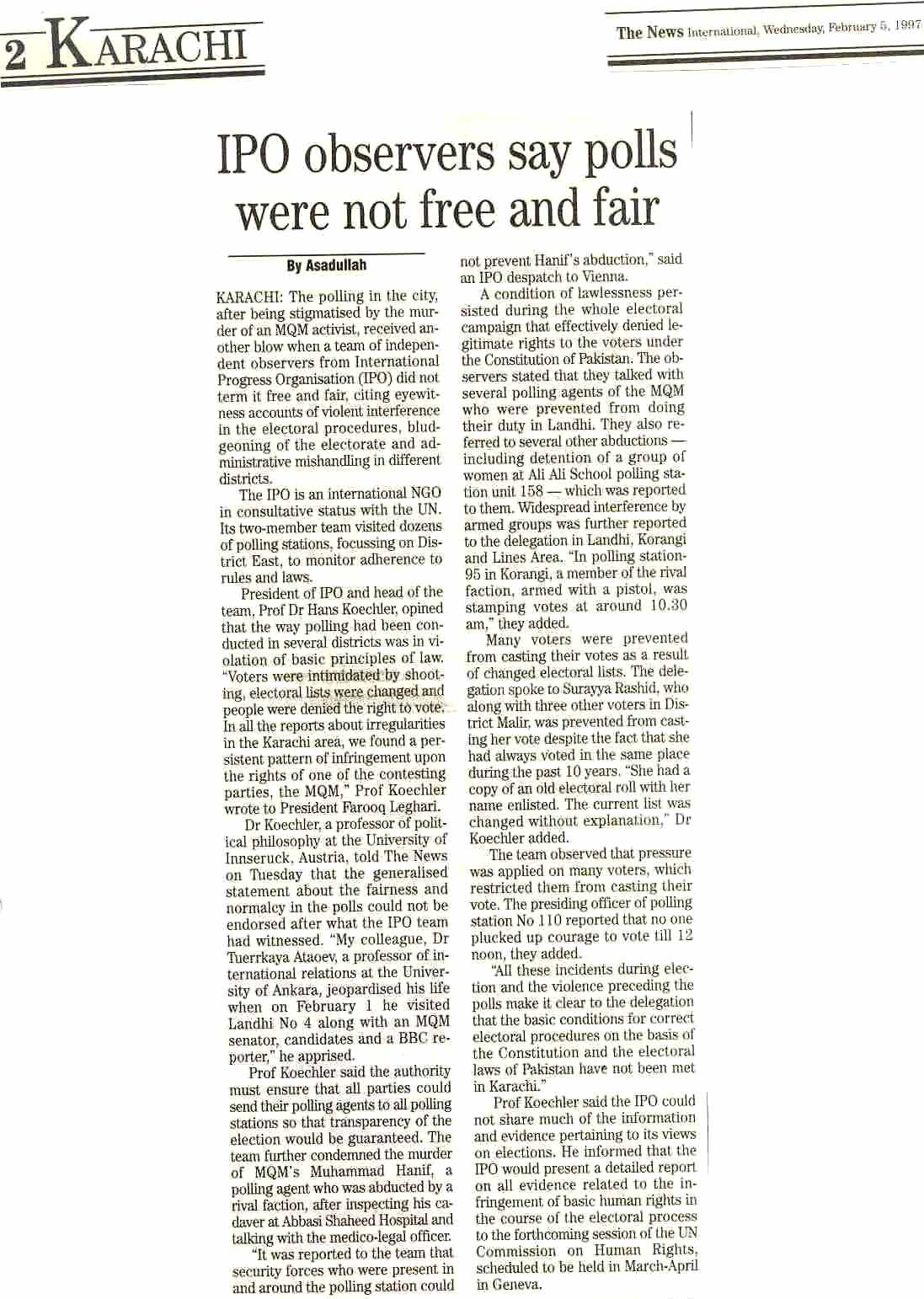
An observer team of the International Progress Organization (I.P.O.), an international NGO in consultative status with the United Nations, visited Karachi to observe the Pakistani elections on 3 February 1997. The delegation was headed by the President of the organization, Professor Dr. Hans Köchler (Austria).
The delegation of the International Progress Organization hereby presents a summarized report on the evidence related to the infringements upon basic human rights in the course of the electoral process in the Karachi area of Pakistan.
After having visited about a dozen different polling stations in Karachi on the election day between 8 a.m. and 2 p.m. and after having observed the electoral campaign in Karachi in the preceding days, the delegation has come to the conclusion that the elections cannot be considered free and fair because of violent interference in the electoral procedures, intimidation of the electorate and administrative mishandling in several districts of Karachi. Because of these circumstances, the electoral procedures were not in conformity with the provisions of Art. 25 (b) of the International Covenant on Civil and Political Rights and with Art. 21 (3) of the Universal Declaration of Human Rights.
The delegation of the I.P.O. took note of numerous incidents and acts of violence and investigated several incidents on the spot:
-
Muhammad Haneef, a polling agent of the MQM Party, was abducted with three others (who managed to escape) by members of the Haqiqi faction. He was severely beaten and died. The delegation of the I.P.O. inspected the dead body in the Abbasi Shahid hospital and spoke to the medical staff. Mr. Haneef was the brother of MQM candidate M. Hussein. It was reported to the delegation that Pakistani security forces (army and rangers) who were present in and around the polling stations did not prevent Mr. Haneef's abduction.
-
The delegation visited another MQM member in the same hospital who suffered severe injuries as a result of attacks by the same group.
-
The delegation spoke to several polling agents of the MQM party who were prevented from doing their job in polling stations in the Landhi area of Karachi. Among fourteen of that group, six were thrown out by Haqiqi men and eight were kidnapped. The delegation interviewed five of those who were thrown out. They reported that two of them were severely beaten. Those abducted were unaccounted for at the time the delegation met with the others.
-
Several other abductions − including an abduction of a group of women at Ali Ali School polling station Unit 158 − were reported to the delegation.
-
Widespread interference by armed groups was further reported to the delegation from the districts of Landhi, Korangi and Lines Area. In polling station 95 (Haroon Siddiqui in Korangi) a member of the Haqiqi grouped, armed with a pistol, was stamping votes at around 10.30 a.m.
-
Many voters were prevented from casting their votes as a result of changed electoral lists. The delegation spoke to Ms. Sureyya Rashid who, along with three other voters from her district, was prevented from casting the vote in the district of Malir in spite of the fact that she always cast the vote in the same place since more than ten years. She showed the copy of an earlier voters' list which included her name. This list had been changed without explanation.
-
Pressure was exercised on many voters. As a result of this, many citizens were afraid to cast their vote. The chief of polling station no. 110 reported that no one showed the courage of appearing to vote until 12 noon.
-
Numerous other cases of harassment of voters have been reported to the delegation of the I.P.O. It is noteworthy that the contingents of Pakistani security forces stationed in all voting areas did not prevent these incidents and did not come to the rescue of those kidnapped.
All these incidents in several districts of Karachi during the day of election and the violence preceding the election day made it clear to the delegation of the I.P.O. that the conditions for correct electoral procedures on the basis of the Constitution and the electoral laws of Pakistan have not been met in the above-mentioned districts of Karachi. A condition of lawlessness persisted during the whole electoral campaign and on the election day itself. One electoral group in particular, the MQM, was seriously hindered in its campaign and has effectively been denied its legitimate rights under the Pakistani Constitution.
Professor Dr. Türkkaya Ataöv (Turkey), a member of the delegation of the I.P.O., found himself in a dangerous situation when he visited the Landhi no. 4 area in Karachi on 1 February with a group of Senators and candidates of the MQM. Several people were injured as a result of unprovoked attacks. Again, the security forces did not provide adequate protection to legitimate representatives of a political party of Pakistan.
The President of the I.P.O., Prof. Dr. Hans Koechler, sent a special message to President Leghari of Pakistan on the day before the elections urging him to ensure that all parties contesting the elections will be able to exercise their constitutional rights and to send their polling agents to all polling stations so that the transparency of elections would be guaranteed.
The delegation of the I.P.O. now has to state that this was not the case in the Karachi area and that serious human rights violations have been committed that prevented large sectors of the population, in particular the Mohajir people, to take part in the electoral process. This was in clear violation of basic human rights, in particular political rights, as guaranteed by international covenants.
Prof. Dr. Türkkaya Ataöv Prof.
Dr. Hans Köchler
Business Recorder, 4 February 1997

The News, 5 February 1997